Digital forensics plays a critical role in the detection and investigation of cybercrime, data breaches, and other criminal digital incidents. It includes techniques for preserving, analyzing, and interpreting digital evidence resulting from criminal activity or IT security breaches. The goal is to analyze and resolve hacking, data theft, data leakage, or fraud using digital evidence.
IT forensic investigations necessitate a deep understanding of both the methodologies and the regulatory standards essential for maintaining the integrity of evidence. To achieve this, Oneconsult has a highly specialized and multi-certified forensics team, complemented by a state-of-the-art forensics laboratory that is fully equipped and rigorously secured for conducting thorough analyses.

We preserve and analyze digital evidence in accordance with recognized forensic standards to ensure that integrity, traceability, and admissibility are guaranteed at all times.
Our digital forensics specialists reconstruct attacks, data breaches, and security-related events as completely and transparently as possible, based on the available data – even in complex incidents.
Our specialized team has many years of experience in digital forensics, incident response, reverse engineering, and the analysis of complex cyberattacks.
For forensic investigations, we use a professionally equipped and strictly secured forensic laboratory with modern analysis and evaluation tools.
We treat all information, systems, and investigation results with the utmost confidentiality and in accordance with clearly defined security processes.
We present technical findings in a way that is understandable and tailored to the specific audience – including management, IT, legal, compliance, or external parties.
In the event of a cyber incident, we quickly assist companies in analyzing and reconstructing the incident to minimize consequential damage.
In addition to forensic analysis, we provide concrete recommendations for improving IT security and preventing future incidents.
Our digital forensics approach follows a clearly structured, proven process to efficiently investigate digital incidents, secure evidence in a manner that stands up in court, and deliver reliable results.
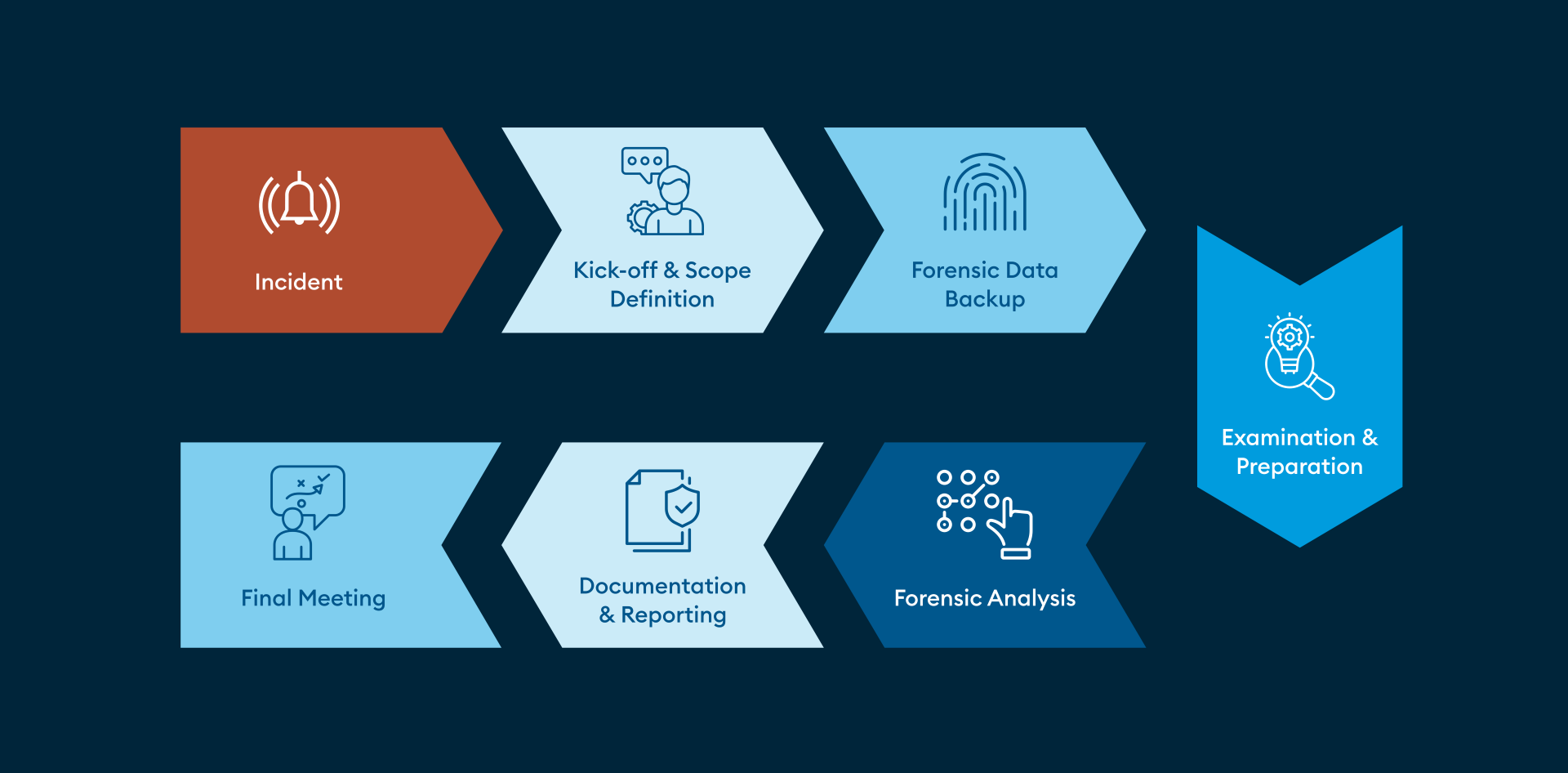
During the kick-off meeting, we work together to define the scope of the examination, the objectives, and the relevant systems, data sources, and hypotheses. This ensures that the digital forensics examination is conducted in a targeted and efficient manner.
We collect and back up all relevant digital data and systems in a forensically sound manner. In doing so, we consistently ensure the integrity, traceability, and admissibility of the evidence in court.
As part of the digital forensics examination, we analyze the backed-up data, extract relevant information, and prepare it in a structured manner for analysis using automated and manual processes.
We analyze the prepared data, reconstruct the incident, and identify correlations, attack vectors, and possible causes. The goal is a precise and traceable reconstruction of the digital events.
We document the results of the digital forensics examination in a clearly structured final report. This includes a management summary, the initial situation, objectives, hypotheses, methodology, results of the forensic examination, findings, and any recommendations for action.
During the final meeting, we present the results and discuss the next steps. Subsequently, the secured evidence is reviewed and securely deleted or destroyed to ensure confidentiality and data protection.

For over 15 years, Oneconsult has been supporting companies, government agencies, and organizations in the professional investigation of cyber incidents, the legally admissible preservation of digital evidence, and the analysis of complex security incidents. Our specialized digital forensics and incident response team combines many years of practical experience with recognized certifications such as GCFA, GCFE, GDAT, GRID, GREM, and GCFR.
We conduct forensic investigations in accordance with established international standards and methods such as ISO/IEC 27035, ISO/IEC 27037, and ISO/IEC 27041. As a full member of FIRST (Forum of Incident Response and Security Teams), our clients also benefit from up-to-date expertise, international best practices, and experience gained from real-world cyber incidents.
Whether it’s a cyberattack, data theft, data leakage, or suspected internal manipulation, we provide you with fast, discreet, and professional support in analyzing, reconstructing, and investigating digital incidents.
Digital forensics refers to the systematic collection, analysis, and evaluation of digital evidence on computers, servers, mobile devices, cloud platforms, and networks. The goal is to investigate cyber incidents, examine security breaches, and gain reliable insights into the sequence of events.
A digital forensic investigation usually starts with securing digital evidence to prevent alterations or data loss. The secured data is then analyzed to extract relevant information and evidence. Forensic processes and recognized tools are applied to recover deleted files, analyze metadata, examine network communications, and identify suspicious activities. The findings are documented and can be used as evidence in legal proceedings.
Digital forensics helps technically analyze cyber incidents, identify causes, and reconstruct the course of an attack as precisely as possible. The goal is to provide clear answers to the most important questions surrounding an incident:
The extent to which an incident can be reconstructed depends, among other things, on the availability of relevant data sources. Therefore, a suitable logging and monitoring strategy is recommended to enable an efficient digital forensics investigation in the event of an incident.
An IT forensic investigation is always useful when there is a cyber incident, a security breach, or a suspicion of unauthorized activity. Typical use cases include, among others:
In addition, an IT forensic investigation may be necessary to comply with legal or regulatory requirements. These include, for example, investigation and reporting obligations related to data breaches under the GDPR or the DSG.
Yes. Digital forensics investigations are conducted in accordance with recognized forensic standards. Digital evidence is secured and documented in a way that ensures its integrity and traceability. The results can be used for internal investigations, employment law proceedings, insurance claims, or legal disputes.
In many cases, yes. IT forensic methods make it possible to partially or completely reconstruct deleted files, user activities, system events, or network connections. Whether and to what extent this is possible depends, in particular, on how much time has passed since the incident and which data sources are still available.
DFIR stands for Digital Forensics and Incident Response and describes the combination of the technical investigation of cyber incidents (digital forensics) and the operational response to security incidents (incident response).
While digital forensics aims to reconstruct the sequence of events of an incident and secure digital evidence, incident response focuses on containing the attack, restoring business operations, and preventing further damage.
The duration of an IT forensic investigation depends on the scope of the incident, the number of affected systems, the volume of data, and the objectives of the investigation. In the case of urgent cyber incidents, initial findings are often available within a few hours or days. More extensive investigations – for example, in cases of complex attacks or suspected data theft – can take several days to weeks.
Availability Monday to Friday 8:00 a.m. – 6:00 p.m (exception: customers with SLA – please call the 24/7 IRR emergency number).
Private individuals please contact your trusted IT service provider or the local police station.
For more information about our DFIR services here:

Don’t miss anything! Subscribe to our free newsletter.
