With customized penetration tests, Oneconsult uncovers security vulnerabilities in networks, cloud environments, IT and OT systems, as well as AI systems and AI agents. You receive verified findings, a risk-based assessment, and specific remediation recommendations.
A penetration test (short: pentest) is a controlled, authorized security assessment in which our experts simulate the methods used by real attackers to specifically search for vulnerabilities in your systems. A pentest is suitable for companies of all sizes that need to secure applications, IT sys-tems, cloud and AI systems (e.g., AI agents), as well as IoT or OT systems. The result are summarized in a report that presents all identified security vulnerabilities, their associated risks, and specific remediation measures.
As a specialized penetration testing provider, Oneconsult relies on a team with recognized industry certifications, including OSCP, OSED, OSEP OSWE, and OSWP from OffSec, as well as Burp Suite Certified Practitioner (BSCP), Certified Red Team Operator (CRTO), and others. For more than 20 years, penetration testing has been our core competency. With our team of more than 30 pentesters, we complete several hundred projects each year and draw on extensive hands-on experience.
Our penetration testing services cover the entire spectrum of connected systems, from (web) applications, IT infrastructures, and cloud environments to IoT devices, OT environments, AI systems, and AI agents. Each service is tailored to the specific attack vectors and risks associated with the respective technology.
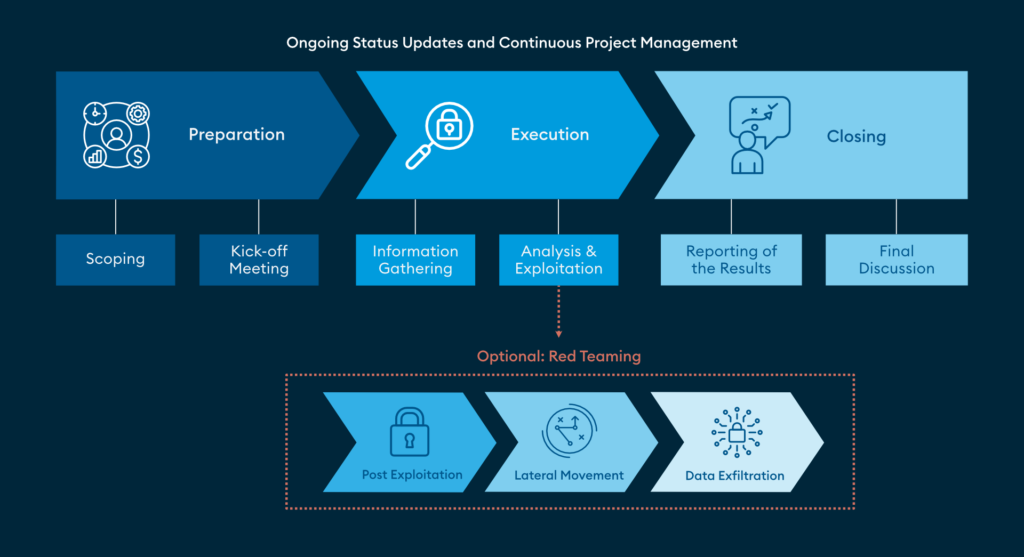
A penetration test at Oneconsult consists of three phases: from preparation through technical implementation to completion, including documentation and final discussion. Throughout the engagement, we keep you informed by means of regular status updates and transparent project management. Critical findings are reported immediately. We follow recognized standards such as OSSTMM, NIST, and OWASP to ensure a structured approach, reproducible results, and a high degree of comparability across different assessments.
The final report contains the following items:
Every penetration test can be flexibly tailored to your objectives. The four key design dimensions include:
You either provide our experts with valid login credentials (authenticated) or deliberately choose not to do so (unauthenticated). Authenticated testing enables us to conduct an assessment from an internal perspective, while unauthenticated testing simulates the approach of external attackers without login credentials.
Testing is conducted either from the internet (outside) or from the internal network (inside). This allows for targeted testing of both externally exposed attack surfaces and risks within the organization’s own infrastructure.
The tests are conducted entirely by our experts (expert-led) or – where desired and appropriate – supplemented with AI support. The use of AI facilitates pattern recognition, identifying potential attack paths, and expanding the scope of the tests. In all cases, the results are validated by our experts and translated into reliable conclusions.
You provide our experts with extensive (white-box), limited (gray-box), or little to no information (black-box) about the test subject prior to the test. The less information our testers receive in advance, the more realistically the test reflects the approach of external attackers. More information allows for a more targeted and comprehensive assessment of the test subject.
The focus of a penetration test is on the technical evaluation of specific test objects. If you’d also like to assess your organization’s overall detection and response capabilities, it’s worth taking a look at the differences between penetration test and red teaming.
Penetration testing has been our core competency for over two decades. Our well-coordinated team of more than 30 pentesters carries out several hundred projects each year.
Oneconsult is ISO27001 certified, and our specialists hold recognized industry certifications, such as OSCP, OSED, OSEP OSWE, and OSWP from OffSec as well as BSCP, CRTO, and others.
We use AI only where it is desired, permitted, and beneficial, in accordance with the principle of “hu-man-led, AI-assisted” – that is, used in a controlled manner, verified transparently, and always over-seen by experts.
We test all types of networked components, ranging from traditional IT and cloud systems to IoT/OT and AI/LLM systems.
Our reports include an easy-to-understand management summary as well as specific recommendations for actions to sustainably enhance your cyber resilience.
Before providing a quote, we work with you to define the exact scope of testing to ensure maximum relevance and full cost transparency.
Our assessments support regulatory requirements (e.g., TLPT and DORA) and align with standards in-cluding OWASP, NIST, OSSTMM, and CIS Benchmarks.

It is not possible to provide a flatrate estimate for the costs of a penetration test. They depend on the specific scope of the test and are calculated transparently. The most important factors include:
Since every company has a unique infrastructure, we work with you to define the scope of the project in advance during a scoping meeting. This enables us to provide you with a customized quote with no hidden costs.
No. AI speeds up specific tasks, such as identifying known vulnerabilities, but it does not replace the creative, context-based analysis performed by an experienced penetration testing team. Complex attack chains, logic flaws, and manual verification remain core human competencies. AI serves as a tool in this context, but it is not a substitute.
To identify and address vulnerabilities before attackers can exploit them. A pentest provides a realistic assessment of your security level, helps ensure compliance with regulatory requirements (e.g., DORA, ISO 27001), and protects against financial and reputational damage.
A penetration test is typically conducted in three phases. As part of the preparation, a scoping meeting and a kick-off meeting are held together with the client. Afterward, the technical execution begins with gathering information about the target systems, followed by the identification, analysis, and controlled exploitation of vulnerabilities. Finally, you will receive a final report containing the results and recommended measures. Optionally, the results can be reviewed in a final discussion. Throughout the entire project, we keep you informed with regular status updates and report critical findings immediately. Our experts use the same methods and techniques as real attackers do in order to reliably identify and thoroughly assess vulnerabilities under real-world conditions.
A part of a network penetration test, network components – such as servers, firewalls, services, and configurations – are checked for exploitable vulnerabilities. The goal is to identify attack vectors within the network and secure it by providing clear recommendations for action.
A part of a network penetration test, network components – such as servers, firewalls, services, and configurations – are checked for exploitable vulnerabilities. The goal is to identify attack vectors within the network and secure it by providing clear recommendations for action.
about the test object in advance, such as its architecture, source code, or access credentials. This allows vulnerabilities to be identified particularly efficiently and comprehensively – including those that are barely detectable from the outside.
A vulnerability scan identifies and prioritizes known vulnerabilities, usually automatically, and reveals which vulnerabilities theoretically exist. A penetration test goes a step further: vulnerabilities are manually verified and, if necessary, exploited in a controlled manner to demonstrate the actual damage an attacker could cause. In addition, it also uncovers unknown and logical vulnerabilities – such as errors in business logic or attack vectors that arise only through the combination of several individual findings and are not detected by automated scans. In short: A vulnerability scan checks the breadth, while a penetration test checks the depth.
A penetration test identifies and validates vulnerabilities in a defined environment. In Red Teaming, a realis-tic cyberattack is simulated, and an attempt is made to achieve defined objectives using the best possible attack path. It also assesses the organization’s defense, detection, and response capabilities. Learn more about the differences in our blog post “The Differences Between Penetration Test and Red Teaming”.
The number of reported cyber incidents in Switzerland has remained high for years. In 2025 alone, the Federal Office for Cybersecurity (BACS) received more than 64,000 reports of cyber incidents. A key factor in the success of many attacks is technical vulnerabilities that were not detected prior to the attack. Penetration tests help identify these risks early on.
Availability Monday to Friday 8:00 a.m. – 6:00 p.m (exception: customers with SLA – please call the 24/7 IRR emergency number).
Private individuals please contact your trusted IT service provider or the local police station.
For more information about our DFIR services here:

Don’t miss anything! Subscribe to our free newsletter.
